Pages

Showing posts with label Obama. Show all posts

Friday, 9 November 2012

Obama to make historic visit to Myanmar

Trip later this month will make him the first sitting US president to visit Myanmar, despite ongoing ethnic violence. 


President Barack Obama later this month will become the first US leader to visit Myanmar, marking the strongest international endorsement so far of the fragile democratic transition in the once-isolated Southeast Asian country after decades of military rule.
Obama will travel to Myanmar as part of a November 17-20 tour of Southeast Asia, which will also include stops in Thailand and Cambodia, the White House said on Thursday.
It will be his first international trip since winning re-election earlier this week.
He is going ahead with the trip despite recent sectarian violence in western Myanmar, which has drawn concern from the United States and European Union.
UN human rights investigators have criticised the government's handling of the strife between Buddhists and minority Muslims, and some Myanmar exiles see Obama's trip as premature, before political reforms have been consolidated.
The visit to Myanmar, the first by a sitting US president, will give Obama a chance to meet president Thein Sein and opposition leader Aung San Suu Kyi to encourage the "ongoing democratic transition," White House spokesman Jay Carney said.
Could trip 'undermine activists'?
Obama's presence in Myanmar, also known as Burma, will highlight what his administration sees as a first-term foreign policy achievement and a development that could help counter China's influence in a strategically important region.
Washington takes some credit for a carrot-and-stick approach that pushed Myanmar's generals towards democratic change and led to Thein Sein taking office as president in 2011.
Obama will be in Myanmar on November 19, according to a senior government source in Yangon.
While marking a milestone in US efforts to promote reform in Myanmar, he also risks criticism for rewarding the new government too soon, especially after security forces failed to prevent bloody ethnic violence in the west of the country.
Some 89 people were killed in clashes between Buddhist Rakhines and minority Muslim Rohingyas, according to the latest official toll covering the last 10 days of October. Many thousands more have been displaced by the violence.
"The ethnic minorities, all the voices from the affected areas, [have] started to question the visit," Aung Zaw, editor of Irrawaddy Magazine, an independent publication based in neighbouring Thailand, told Al Jazeera.
"They feel it's premature to visit because they think that the president can wait until 2014, when Burma is going to be holding an ASEAN summit... people feel that it's too fast to visit Burma this time."
The US Campaign for Burma, an exile group, said Obama's trip could "undermine the democracy activists and ethnic minorities," but that if the president was intent on going, he should broaden his agenda to include meetings with the still-powerful military and an address to parliament.
A senior administration official said Obama, who will also speak to civil society groups, was "acutely aware" of concerns about human rights, ethnic violence and political prisoners in Myanmar and would address those issues during his visit.
The United States eased sanctions on Myanmar this year in recognition of the political and economic changes under way, and many US companies are looking at starting operations in the country, located between China and India, which has abundant resources and low-cost labour.
In November 2011, Hillary Clinton became the first US secretary of state to visit Myanmar in more than 50 years.
Obama met Suu Kyi, a fellow Nobel Peace Prize laureate, on her visit to the United States in September. Thein Sein was also in the United States to attend the opening of the UN General Assembly in New York, but the two leaders did not meet.



Tuesday, 16 October 2012

Obama and Romney set for second debate


US President Barack Obama and Republican rival Mitt Romney face off in their second high-stakes debate on Tuesday night at a crucial juncture in the presidential campaign.
The Tuesday debate at Hofstra University in Hempstead, New York, offers both candidates their best chance for a breakout moment with time running out in what promises to be one of the closest presidential contests in recent US history.
The pressure is on Obama who has vowed to put up more of a fight in an effort to overcome his lackluster, momentum-stalling performance in the candidates' first debate on October 3.

Battleground states
Romney will likewise need to turn in a repeat of his strong showing in the initial face-to-face-confrontation, a performance which propelled him into a virtual tie in nationwide polling.
Obama still hangs on to small leads in many of the nine key swing states that are likely to determine which man occupies the White House on Inauguration Day on January 20.
The so-called battleground states - those that do not reliably vote either Republican or Democratic - take on outsized importance in the US system where the president is chosen not by the nationwide popular vote but in state-by-state contests.
The candidates will take questions on domestic and foreign policy from an audience of about 80 of the coveted uncommitted voters whom both campaigns are so furiously courting.
The town hall-style format makes it especially tricky for Obama to strike the right balance in coming on strong against Romney without turning off the audience - and tens of millions of television viewers - by going too negative.
With early voting already under way in dozens of states, including such battlegrounds as Ohio and Iowa, the candidates will have little time to recover from any missteps in the debate.
Through Monday, either absentee or in-person early voting had begun in 43 of the 50 states.
In the first debate, Obama seemed caught unawares and unprepared to respond to Romney's sudden shift to more moderate positions from the hardline policies he had advocated during the fight for the Republican nomination.
The candidates will engage in a final debate next Monday in Boca Raton, Florida, where the emphasis will be on US foreign policy.

Wednesday, 26 September 2012

Madonna Explains Her Calling Obama 'a Black Muslim'

Madonna
See larger image
Photo credit: Mr Blue/WENN
Madonna answers people's questions as to why she called President Barack Obama "a black Muslim" when giving him an endorsement at her concert in Washington D.C. The Material Girl explains her statement, "I was being ironic on stage."

"Yes I know Obama is not a Muslim - though I know that plenty of people in this country think he is. And what if he were? The point I was making is that a good man is a good man no matter who he prays to. I don't care what religion Obama is - nor should anyone else in America."

Madge seemed to confuse her fans when she called Mr. President "a black Muslim in the White House" while voicing her support for him. "It means there is hope in this country," she explained. "And Obama is fighting for gay rights, okay? So support the man, goddamnit!"


You might also wanna Join this Site and start Earning

Thursday, 1 December 2011

Inside Obama's re-election math

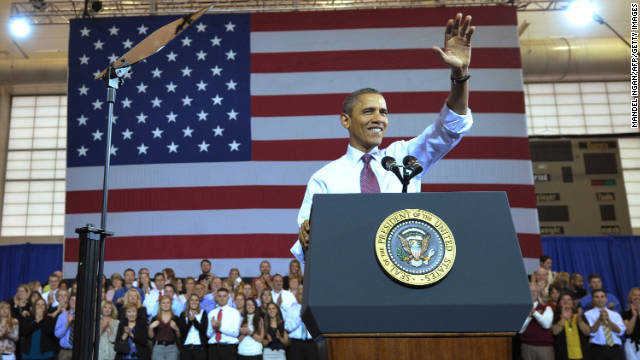
President Barack Obama makes his way onto the stage to speak on payroll tax cuts this week in Scranton, Pennsylvania.  
 
 
Washington (CNN) -- As President Barack Obama wraps up his eighth trip this year to Pennsylvania, some political insiders say he can't sell his brand in the Keystone State. The region's white, blue-collar voters, they say, have tuned him out.
So why, then, was he in Scranton this week pushing the payroll tax cut?
It may be that, despite the conventional wisdom, the Obama re-election campaign has a different, larger strategy quietly developing. They know that the 2012 election will likely be decided by a razor-thin margin. It will be a battle for every vote.
Obama challenges Republicans on payroll tax cut
With less than a year before Election Day and having raised more than $100 million, the Obama campaign believes it has the time and the money to compete in the dozen or so traditional battleground states as well as take on a few new states it feels have been put into play since 2007.
Now, Team Obama is focused on finding multiple ways to get to 270 electoral votes.
The path to 270
First, the president is aiming to win all the states John Kerry won in 2004. That would bring him to 246 electoral votes, including Pennsylvania's mother lode of 20. Add New Mexico, which the president won in 2008, and that's five more electoral votes. Now he's at 251.
Then it gets hard. The final 19 electoral votes would come through a process of mix and match.
The scenario getting the most buzz inside the beltway: locking in Virginia (13 electoral votes) and North Carolina (15 electoral votes) which would get him to 279.
Democratic operatives like the demographics of these states because they see an influx of the young, highly educated workers who tended to be Obama voters in 2008.
But some Republicans doubt Obama can take North Carolina, in particular, pointing to its high unemployment rate -- currently around 10.4%, according to the Bureau of Labor Statistics -- and voting history: Obama won the state by only 14,000 votes in 2008 (or 1%), and it went for the Republican candidate in seven out of the past eight elections. Before Obama, Jimmy Carter in 1976 was the last Democrat to win North Carolina.
A win in Florida, with its 29 electoral votes, would also do the trick. But if Florida's popular junior Sen. Marco Rubio is on the Republican ticket, the state could suddenly be out of reach. Even without Rubio, it will be a tough battleground state.
There are other paths to the 19 electoral votes they need.
Ohio has 18 electoral votes (yes, they still plan to campaign there), plus any of these other states: Nevada (6), Iowa (6), Colorado (9) or even Arizona (11), which, thanks to its growing Latino population, could now be in play.
Back to Pennsylvania
But Republicans won't simply roll over in those states, especially in Pennsylvania. They have success in the last midterm elections to build on.
In 2010, Republican Pat Toomey won the open U.S. Senate seat in Pennsylvania. Republicans also picked up five new House seats and took over the governor's mansion in the last election.
So now, top Republicans say that with the president's approval rating down to 44% in Pennsylvania, according to a recent Quinnipiac poll, coupled with his early struggle to win in the western part of the state against Hillary Clinton in the 2008 primaries, they may actually have a shot at taking the traditionally Democratic state in 2012.
But Democrats argue that they'll hold those 20 electoral votes for three reasons:
Obama: Campaigner in chief?
Carney: President operates by the book
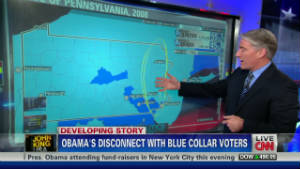
JKUSA: Obama and blue collar voters
1. They have a 1 million-plus advantage among registered voters.
2. Turnout for the midterms was so low -- around 41% -- it wasn't necessarily a true reflection of voter sentiment.
3. In 2008, the president won the state by more than 10 points, making it likely, in their view, that he can at least eke out a victory this time.

Meanwhile, Republicans also plan on fighting for the Kerry states of Wisconsin and Michigan.
However, the Obama team has alternate routes to 270 if they lose some of the Kerry states.
For example, if he loses Pennsylvania -- which would take him down to 226 -- but wins North Carolina (15), Virginia (13) and Colorado (9), and adds two of the following three states -- Iowa (6), New Mexico (5), Nevada (6) -- he crosses 270.
Or he could lose Pennsylvania -- down to 226 -- and Wisconsin -- down to 216 -- but pick up Florida (29), North Carolina (15) and Virginia (13) and he crosses the finish line. Add Ohio (18) and Arizona (11) to the list of options and the possibilities grow.
Of course one wonders whether the president could sweep other battleground states if he can't prevail in Pennsylvania and hold the Kerry map.
Any road map to victory requires one big dose of reality: The president will have to fight hard to win votes in any battleground state, old or new, given the state of the economy.